

Hiring a Plumbing Contractor in Portland: Contracts, Permits, and What to Expect
Finding a trustworthy plumbing contractor Portland can be the difference between a quick, code-compliant fix and a long, expensive headache when permits, inspections, and change orders are involved. This practical guide walks Portland homeowners and small business owners through verifying licenses and insurance, reading and negotiating contracts, navigating City of Portland permits and inspections, comparing bids, and what to expect from estimate to final sign-off.
Verify license, insurance, and local standing before you invite a contractor
Start here: confirm the contractor is legally allowed to work in Oregon. Look up the business or individual on the Oregon Construction Contractors Board using the Oregon CCB license lookup. An active CCB record is not just formality – it shows the contractor met bonding, registration, and basic regulatory requirements. A suspended, expired, or inactive status is an immediate stop sign.
What to check, and what it means
License details matter. On the CCB record look for the business name, license number, start date, and any listed complaints or disciplinary actions. A contractor with a long clean record and local references is preferred, but a single old complaint does not automatically disqualify a professional if they handled it and show recent good work.
Insurance is non negotiable. Ask for a Certificate of Insurance that shows general liability (common minimum is $1,000,000 per occurrence), and workers compensation if the crew is covered under Oregon law. Do not accept verbal assurances. Confirm the COI lists the insurer and a phone number so you can call to verify coverage if necessary.
- Phone checklist before an on-site estimate: License number and business name as on CCB, insurance carrier and COI date, who pulls permits, expected deposit amount, and at least one local reference for a similar Portland job.
- Subcontractors and vendors: Ask whether subs will work on the project and require the contractor to provide COIs and lien waiver commitments for them.
- Permit responsibility: Confirm in writing who will file permits with the City of Portland Bureau of Development Services and how permit fees will appear on the estimate.
Reality check and trade-off. The cheapest bid often comes from contractors who cut corners on insurance or permits. Paying a few hundred more for a licensed plumber who will pull permits and carry insurance is upfront cost that avoids major liability and resale headaches later.
Concrete example: A homeowner in North Portland called two local plumbers for a water heater swap. One gave a low cash-only price and no license number; the other provided a CCB number, a COI showing $1,000,000 liability, and said they would pull the permit. The homeowner chose the licensed firm; later the city inspection flagged an improper venting detail that the licensed team corrected under permit without dispute.
If a contractor dodges providing a license number, COI, or written permit policy, treat that as a red flag and walk away.

Next consideration: Once credentials check out, use the phone checklist before scheduling an on-site estimate so the first visit is productive and you avoid contractors who refuse permits or hide subcontractor arrangements.
Itemized estimate and comparing bids: what to compare beyond price
Lowest number is a starting point, not a decision. Look for an estimate that lets you compare apples to apples – readable line items, brands, permit handling, and a clear change-order mechanism. A one-line total hides risk.
What a usable, comparable estimate looks like
| Estimate line item | What to check | How to compare across bids |
|---|---|---|
| Scope description | Does it name the work precisely – e.g., replace 50 gal gas water heater, include venting and seismic straps? |
Prefer the estimate with specific actions and exclusions over vague phrases like replace water heater |
| Materials and brands | Are brands, model numbers, and warranty lengths listed? | Normalize by substituting equal-brand pricing or ask bidders to quote the same model |
| Permits and inspections | Does the bid list permit fees, who pulls permits, and inspection milestones? | If a bid omits permits, add the expected permit fee yourself or mark that bid lower quality |
| Labor breakdown | Hours, crew size, and overtime assumptions should be visible | Convert time-and-materials bids to a not-to-exceed number for comparison when possible |
| Disposal and site restoration | Is clean-up, disposal of old fixtures, and any patching included? | A cheap bid that leaves you with demolition waste or unfinished cuts costs more later |
Practical trade-off: fixed-price offers certainty but can include contingencies or higher margins for unknowns. Time-and-materials is fair when concealed conditions are likely, but insist on a written cap and daily reporting. In Portland jobs where old cast-iron or hidden gas fittings are possible, a T&M approach with a written allowance is often the honest choice.
Concrete example: Two bids for trenchless sewer repair came in. Bid A was lower but listed only trenchless replacement with no CCTV video or warranty on root intrusion. Bid B cost 20 percent more, included a pre-repair camera inspection, a 2-year workmanship warranty, and an itemized allowance for a small access excavation if the pipe cannot be jetted. The homeowner paid more for Bid B because the camera reduced unknowns and protected against repeated failures.
If a bid does not mention permits or inspection sign-offs, treat that as non-comparable until you get written confirmation of the contractor's permit plan.

Next consideration: convert the winning estimate into contract language that locks in materials, permit responsibility, payment milestones, and a signed change-order process before any work begins.
Contracts: required clauses and sample language to look for
Contracts turn an estimate into obligations. Don’t treat a signed estimate as optional language — a clear contract is the single best tool you have to limit surprises, assign permit responsibility, and set how change orders get handled on a plumbing job in Portland.
Must-have clauses. At minimum the contract should name the exact scope (including model numbers or materials), start and target completion dates, who files and pays for permits, a milestone payment schedule, a written change-order procedure with hourly or not-to-exceed caps, explicit workmanship warranty length and coverage, and a clause requiring unconditional lien waivers from subs/suppliers before final payment.
Practical trade-off. Fixed-price contracts give predictability but vendors often embed contingencies for unknowns into the price. For jobs with likely concealed conditions (older homes, repipes, sewer repair), a time-and-materials contract with a documented allowance and a firm cap is usually more honest — provided you insist on daily time logs and pre-authorization for work beyond the allowance.
Sample contract phrasings to ask the contractor to put in writing
- Scope confirmation: Contractor will supply and install a
50-gallongas water heater, Model ABC123 (brand X), including venting, seismic straps, and insulation; work includes removal and lawful disposal of existing unit and patching of floor to within 2 inches of original finish. - Change-order process: Any work outside the written scope will require a written change order describing work, price, and schedule impact. No work beyond the scope will commence without the homeowner's signed authorization; emergency work necessary to protect life or property will be documented and priced within 24 hours.
- Warranty definition: Contractor warrants workmanship for 2 years from final inspection. Manufacturer warranties on parts apply separately; contractor will provide part receipts and the manufacturer warranty registration as part of final documentation.
Concrete example: A southeast Portland homeowner contracted for a shower replacement under a fixed-price contract. During demo the plumber found a rotten subfloor and corroded drain stack. Because the original contract required written change orders and set a $2,500 allowance for concealed conditions, the contractor submitted a photographed condition report and a signed change order authorizing the repairs and revised permit. The job proceeded without the payment dispute that often follows surprise discoveries.
What people miss in practice. Many homeowners assume manufacturer warranties cover installation problems; they rarely do. Insist the contract separately spell out contractor workmanship coverage, response times for warranty claims, and who pays for permit re-inspections if an inspection fails because of the contractor's work.
If the contract does not say who pulls permits and how failed inspections will be handled, it is incomplete. Verify permit responsibility and saving final inspection records at signing.
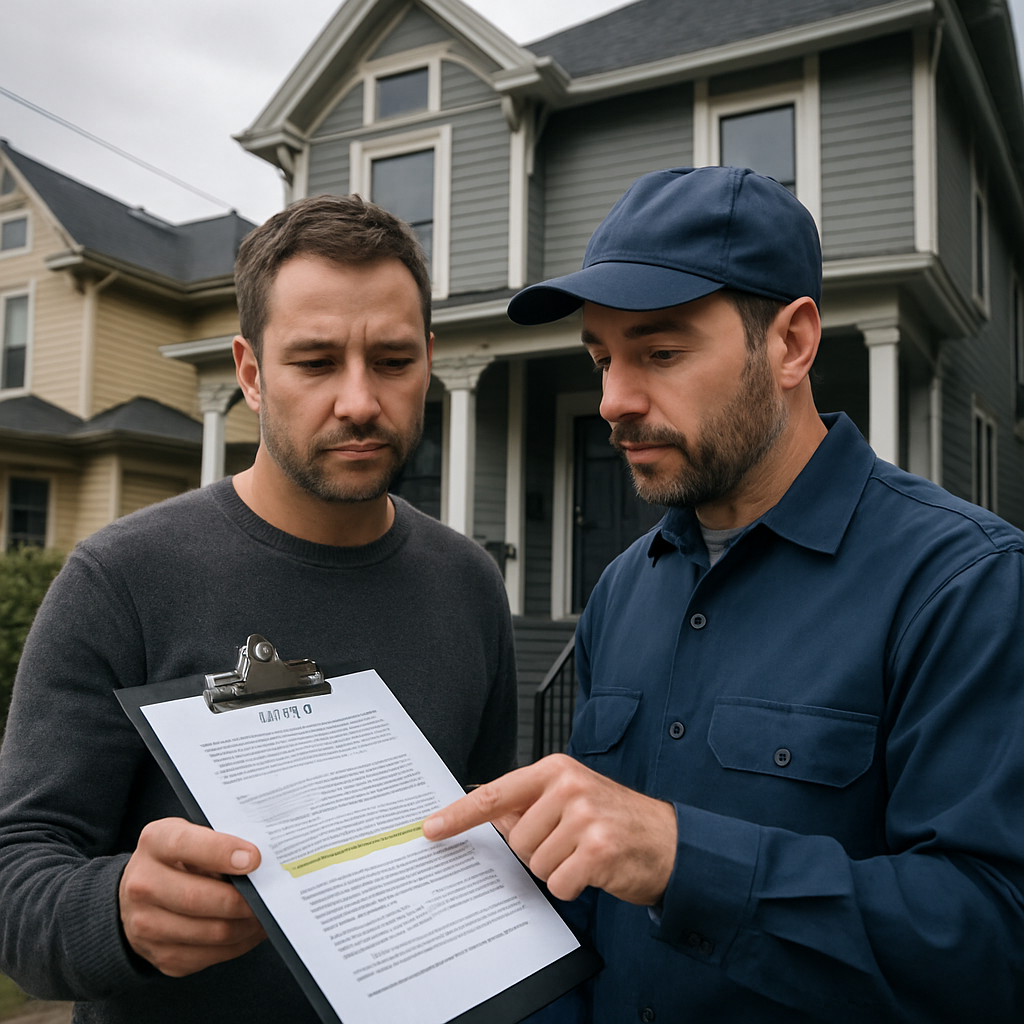
Next consideration: Before you sign, compare the contract language across bids and confirm the contractor will provide final inspection documentation from the City of Portland Bureau of Development Services and an active Oregon CCB license number on the contract.
Permits and inspections in Portland: when they are required and how the process works
Start here: permits change the schedule and shift liability. In Portland many routine-looking jobs trigger a permit because they alter piping, gas, or the building drainage system. Expect permit requirements for things that move or extend existing lines, alter fuel connections, or change sewer or storm drainage paths. For City rules and filing details see the City of Portland Bureau of Development Services permits page.
How the BDS workflow affects your job
Permits are usually submitted by the contractor, but you can be the applicant if you want direct control. Most reputable plumbing contractor Portland will file electronically, pay fees, and schedule inspections as part of the contract. That removes a coordination burden for the homeowner, but it also means you must insist the contract lists the permit number and who pays fees to avoid later disputes.
- Typical inspection sequence: permit intake, rough-in inspection (after piping installed, before wall closure), pressure or gas test where required, and final inspection for sign-off.
- Timing note: simple residential permits can clear in days; complex commercial or cross-trade reviews can take weeks — build a 3-10 business day buffer for small jobs and longer for commercial or historic properties.
- Who pays: property owners are responsible for fees unless the contractor explicitly itemizes them in the estimate; get the fee amount or allowance on the bid.
Practical trade-off: letting a licensed plumber Portland handle permits speeds the process and reduces inspection rejections because experienced contractors know local inspector preferences. The trade-off is less direct control over filings; if you prefer oversight, require the contractor to copy you on the electronic submittal and give you the permit tracking number.
Concrete example: A small business in NE Portland contracted a trenchless sewer replacement. The contractor submitted a pre-repair CCTV with the permit application, which accelerated review by clarifying scope and prevented an extra site visit. When the camera later revealed a collapsed lateral near the property line, the contractor updated the permit and scheduled a separate BES coordination inspection — all logged under the original permit number so the owner had a clear paper trail for the lender and insurance.
Common misunderstandings: homeowners often assume cosmetic fixture swaps never need permits. That is risky — if the swap involves rerouting or new connections, the city may require a permit and a failed disclosure at resale can force costly corrective work. Also, emergency work can be done immediately but should be documented with an after-the-fact permit and inspection to avoid insurance or title problems.
Get the permit number, the name of the filing party, and the scheduled inspection dates in writing before you pay the final invoice.

Next consideration: require the permit tracking number on your contract and budget a time buffer for inspector comments or re-inspections — that prevents deadline creep and protects you from paying for work that needs to be redone after a failed inspection.
Scheduling, timelines, and what to expect during work on your property
Start with realistic calendar blocks — inspections and material lead times drive most schedule slippage. Don’t assume a start date means continuous work; expect pauses while waiting for parts, approvals, or coordinated trades.
How a typical job sequence affects your calendar
A plumbing job is a series of dependencies: permit + rough work + inspection + finish work + final inspection. Each dependency introduces potential delay that should be visible on the project timeline, not treated as hidden risk.
- Permit submission: contractor usually files; expect administrative review time and a permit number to appear on your contract.
- Demo and rough-in: plumber completes concealed piping and pressure/gas testing; this week is when inspectors are scheduled.
- Inspection window: inspectors often book days in advance—plan a 24–72 hour buffer between rough completion and scheduled inspection.
- Finish work: after sign-off, install fixtures and complete restoration; final inspection or certificate of completion follows.
Practical trade-off: paying a premium to move up a contractor's schedule solves urgency but can reduce your leverage on price and change-order discipline. If speed matters—emergency plumbing Portland—you should get firm written terms for temporary fixes versus permanent work, plus a clear timeline for permited follow-through.
On-site daily expectations: expect a clear arrival window, floor and fixture protection, and a single point of contact for questions. Require a short end-of-day note when work stops: what was done, what remains, any emerging issues, and whether shut-offs are required overnight.
Coordination considerations for constrained sites: multi-unit buildings, narrow driveways, or required street permits add scheduling friction. Ask contractors how they will stage deliveries, manage dumpster placement, and coordinate with building managers to avoid last-minute forklift or parking delays.
Inspection reality check: experienced local plumbers factor inspector preferences into their sequencing to reduce re-inspections. That experience matters; it is not a minor convenience. Contractors who know how Portland inspectors document common failure points save days and money in practice.
Concrete example: A homeowner in Sellwood scheduled a mid-size bathroom plumbing remodel. The contractor filed the permit electronically the same week; rough-in took two days, but the earliest inspection slot was five business days out. Fixtures were ordered only after conditional approval of the rough, so the final install waited another week for delivery. The homeowner budgeted three nonconsecutive weeks and avoided rush charges by approving staged deliveries and a pre-ordered fixture allowance.
Ask for a simple Gantt-style timeline before work starts that lists permit milestones, inspection windows, and reasonable buffers for material lead times.
Next consideration: when you accept an estimate, convert the timeline into the contract. Require milestones, inspection responsibilities, and an explicit allowance for re-inspections or concealed-condition delays before you pay the final invoice.
Special cases: emergencies, sewer lines, gas work, and historic Portland homes
Direct rule: these four situations are not routine — treat them as distinct project types with different risk, permit, and contractor-qualification needs. Emergency response prioritizes safety and containment; sewer work is investigative and often uncovers concealed failures; gas work requires a licensed gas fitter and strict testing; historic Portland homes demand allowances for unknowns and preservation rules.
Emergency plumbing — stabilize first, document for permanent repair
Stabilize, then plan. An emergency 24-hour plumber Portland should stop the immediate damage — shutoffs, temporary patching, or safe appliance isolation — but that is not the same as the permanent repair. Always require a written scope and a priced follow-up estimate for the permanent work within 48–72 hours of the emergency visit.
Trade-off to accept: faster response usually costs more and may use temporary materials. That is fine if you insist the contractor documents what was temporary, why, and what the permanent solution will be. Do not let temporary fixes remain permanent by default.
Sewer lines and lateral work — inspect before you excavate
Camera first. Insist on a CCTV inspection before committing to trenching or trenchless replacement. Video narrows unknowns and gives you a negotiation position if a contractor proposes trenchless sewer line replacement Portland OR without documented condition evidence.
Practical limitation: trenchless methods save landscaping but fail when pipes have multiple collapsed joints or bad grades. A good plumbing contractor Portland will present both options and an allowance for a short open cut if trenchless attempts hit an immovable obstruction.
Concrete example: A Sunnyside homeowner reported recurring backups; the chosen contractor ran a CCTV and found root intrusion plus a collapsed bell joint near the property line. The contractor attempted a trenchless repair, encountered the collapse, amended the permit, and completed a short open cut coordinated with the Bureau of Environmental Services — more expensive, but avoided repeated callbacks and a future claim.
Gas line and appliance work — treat certification and testing as non-negotiable
Qualification matters. Gas line installation and repair in Portland requires technicians qualified under Oregon code and often a mechanical or gas permit in addition to plumbing permits. Ask to see the licensed plumber Portland gas fitter credential and the contractor's test reports for pressure and leak checks.
Safety trade-off: same-day fixes by nonqualified crews are dangerous. If a contractor suggests skipping pressure tests, stop. Require documented test results and a final inspection; if the work affects service to the street you may also need coordination with the utility provider.
Concrete example: After a reported gas smell in NE Portland, a licensed crew isolated the line, performed a documented pressure test, and provided a signed scope for a full line replacement that required a separate mechanical permit. The homeowner had the paperwork needed for the utility company and for the permit close-out.
Historic Portland homes — plan for unknowns and preservation rules
Expect the unexpected. Older houses often hide cast-iron laterals, clay sewer lines, or galvanized supply that fails unpredictably when disturbed. The right approach is phased work: noninvasive diagnostics, a photographed record of concealed conditions, and contract allowances for additional work rather than a single all-or-nothing price.
Practical judgment: a full repipe is costly but often the most durable solution in an older house; piecemeal repairs can be cheaper short-term but lead to repeated service calls. Choose repipe when multiple failure modes or inaccessible assemblies are likely, and require the contractor to justify that recommendation with inspection evidence.
- Emergency action checklist: get shutoff, temporary containment, written follow-up estimate within 72 hours, and a permit plan if permanent work alters systems.
- Sewer work checklist: demand CCTV, ask for trenchless feasibility report, confirm who will handle locates and right-of-way coordination, and require a workmanship warranty that covers root intrusion for a defined period.
- Gas work checklist: verify gas fitter qualification, require pressure/leak test reports, and confirm dual-permit filing where applicable.
- Historic-home checklist: require exploratory openings documented with photos, a concealed-conditions allowance, and contractor experience in Portland neighborhoods to manage permit and preservation constraints.
Key point: fast response is valuable, but every emergency or special-case fix must convert into a documented permanent solution with permits and final inspection — insist on that transition in writing.
Next consideration: when you receive an emergency or special-case estimate, convert the diagnostics and contingencies into contract language—attach CCTV clips, test reports, and the permit tracking number to the contract so the work that follows is auditable and enforceable.
After the job: final inspection, paperwork, warranties, and protecting yourself later
Immediate action at hand-off: get proof that the job is complete and code‑compliant before you release full payment. A verbal yes is not enough—inspectors, permits, and signed documents are what protect you months or years down the road.
What to collect the day the crew finishes
Critical items to demand now. Ask the contractor to hand over a final invoice that references the permit number and final inspection date, unconditional lien waivers from subcontractors and suppliers, receipts for major parts (so you can register manufacturer warranties), and clear photos or video of any concealed work (routed pipe runs, behind-wall connections).
- Permit confirmation: a screenshot or PDF of the City of Portland final inspection record from City of Portland Bureau of Development Services.
- Lien paperwork: conditional lien waiver for payment made now and unconditional lien waiver upon final payment.
- Warranty pack: manufacturer paperwork plus a written contractor workmanship warranty with response times and coverage period.
- Evidence: dated before/after photos or short CCTV clips for sewer work; save these with your records.
Trade-off to consider. Withholding a modest retainage (commonly 5 to 10 percent or a fixed small sum) until the permit shows closed and unconditional lien waivers are received gives you leverage to ensure the contractor finishes paperwork. The downside: some contractors resist retainage—if that becomes a standoff, use an escrow arrangement or tie the retainage to a short, fixed window for permit closure rather than an open-ended hold.
How to document and execute a warranty claim. When a problem appears, photograph it, note the date/time, and email the contractor with the permit and invoice numbers attached. Expect an initial acknowledgment within 3 business days and a proposed remediation plan within 10–14 days. If the contractor does not respond, you can escalate with the Oregon CCB or use the proof package to support an insurance or small-claims action.
Maintenance that preserves warranties and prevents callbacks. Flush tank water heaters annually, keep exterior cleanouts accessible, and run a sewer camera inspection every 5 years for older Portland properties with mature trees. Many warranties are voided by neglect; keeping a dated log of routine maintenance saves fights later—attach service receipts to the job file.
Concrete example: A Montavilla homeowner withheld the final 7 percent pending receipt of the City final inspection and unconditional lien waivers. The contractor prioritized closing the permit and supplied the documents within four days; three months later when a small supply fitting leaked, the contractor honored the two-year workmanship warranty and scheduled repairs promptly because the paperwork trail was clean.
Keep a single folder (digital and paper) with permit PDFs, final invoice, lien waivers, warranty documents, and dated photos. That folder is the single thing buyers, insurers, or regulators will ask for later.
Next consideration: archive these records and schedule routine maintenance. If you need help turning a completed job into a maintenance plan, see River City Plumbing services for scheduled inspections and tune-ups at River City Plumbing services.